From the webpage, Iconic Photos: The Day The Twin Towers Fell
We must not forget and we must tell our children not to forget.

9/11 was painful — but so was the harried decade that followed it.

But it was a different poem by Auden that was frequently quoted in the days following 9/11: the unmentionable odour of death/offends the September night, he wrote about the month the Second World War began. The couplet clearly underlined the cyclical nature of violence, destruction, and fanaticism, and perhaps it was also fitting that one of the most famous photos from 9/11 was also taken by a man who once covered the D-Day landings — Marty Lederhandler of AP.

Jonathan Torgovnik returned the next morning to take this photo from the fifth-floor window of the neighbouring 1 Liberty Plaza, which was also in danger of falling. He remembers: “I randomly opened the door to one of the offices, walked in, and got the picture. I remember it being so eerie, thinking of the people who might have been there when it happened, and then their not being there — and yet I felt their presence.”


David Surowiecki took the above photo of people jumping off the towers.

On September 11, Richard Drew was also covering the Fall Fashion Week. He rushed to the site, where he captured the dramatic pictures of the people jumping out of the towers. In most American newspapers, his photos ran once and were never seen again; the memories of “jumpers” were so heartrending, their plunges so traumatic and their suicides so stigmatic that officially and journalistically, they ceased to exist.

Nowhere was this hijacking more blatant than in 9/11 Truther Movement, which held that the American Government perpetrated the attacks and the subsequent cover-up as casus bellorum for Afghanistan and Iraq. One of their claim was that the Pentagon was attacked by a missile, rather than a plane. The above photo taken by Daryl Donley, one of the first photographers to arrive to the Pentagon, became a centerpiece of their argument. Blithely ignoring many eyewitnesses who saw a plane crash, and large pieces of airplane debris recovered from the site, they continue to protest shrilly that there was no plane in Donley’s photo.
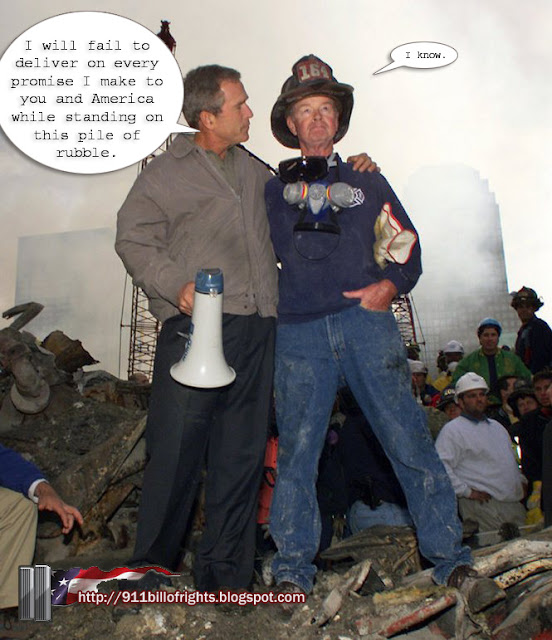
Original photo altered by 9/11 Bill of Rights

We must not forget and we must tell our children not to forget.
9/11 was painful — but so was the harried decade that followed it.
But it was a different poem by Auden that was frequently quoted in the days following 9/11: the unmentionable odour of death/offends the September night, he wrote about the month the Second World War began. The couplet clearly underlined the cyclical nature of violence, destruction, and fanaticism, and perhaps it was also fitting that one of the most famous photos from 9/11 was also taken by a man who once covered the D-Day landings — Marty Lederhandler of AP.
A veteran photographer of 65 years,
Lederhandler had seen plenty of fires and explosions; his advanced age
prevented him from heading out to the WTC site, so the 84-year old
photographer went to the Rainbow Room on the G.E. Building — now more
famously known as 30 Rock, and took a well-framed photo of the disaster
before 30 Rock itself was evacuated.
*
Jonathan Torgovnik returned the next morning to take this photo from the fifth-floor window of the neighbouring 1 Liberty Plaza, which was also in danger of falling. He remembers: “I randomly opened the door to one of the offices, walked in, and got the picture. I remember it being so eerie, thinking of the people who might have been there when it happened, and then their not being there — and yet I felt their presence.”
*
Over three thousand people perished that
day, but the photographs from 9/11 do not show mangled corpses and
bloody carnage. There was an agreement among print media and television
broadcasters not to show any corpses in connection with the attacks, and
when the above picture by Todd Maisel, titled “The Hand, 9/11″ appeared
in the New York Daily News, it was roundly criticized.
But in the following years, this decency
and deference that the American media maintained towards the government
will be strained. Photographs of military funerals, coffins and even
deaths and injuries will be banned by an administration which insisted
that the control of information is vital to national security. Many
photographers would find restrictions and censorships of an embedded
assignment suffocating, but such assignments became a new normal in the
symbiotic and uneasy relationship between the military and the media.
*
David Surowiecki took the above photo of people jumping off the towers.
On September 11, Richard Drew was also covering the Fall Fashion Week. He rushed to the site, where he captured the dramatic pictures of the people jumping out of the towers. In most American newspapers, his photos ran once and were never seen again; the memories of “jumpers” were so heartrending, their plunges so traumatic and their suicides so stigmatic that officially and journalistically, they ceased to exist.
In official records, nobody had jumped;
no one had ever been a jumper. Instead, people fell or were forced out
by the heat, the smoke and the flames. A decade on, this denial still
holds. The 9/11 Museum will consign the story of the jumpers into a
hidden alcove, and there is widespread reluctance to DNA-identify the
remains. In that sense, the jumpers were modern unknown soldiers, and
their pictures, the photographic equivalent of the Tomb of the Unknown Soldier.
We will never know truly their motives,
but retellings of the jumpers’ stories were at best a measured
alteration of history, and a signal of many such revisions to come, as
politicians and pundits continue to hijack the narrative and legacy of
9/11.
*
Nowhere was this hijacking more blatant than in 9/11 Truther Movement, which held that the American Government perpetrated the attacks and the subsequent cover-up as casus bellorum for Afghanistan and Iraq. One of their claim was that the Pentagon was attacked by a missile, rather than a plane. The above photo taken by Daryl Donley, one of the first photographers to arrive to the Pentagon, became a centerpiece of their argument. Blithely ignoring many eyewitnesses who saw a plane crash, and large pieces of airplane debris recovered from the site, they continue to protest shrilly that there was no plane in Donley’s photo.
*
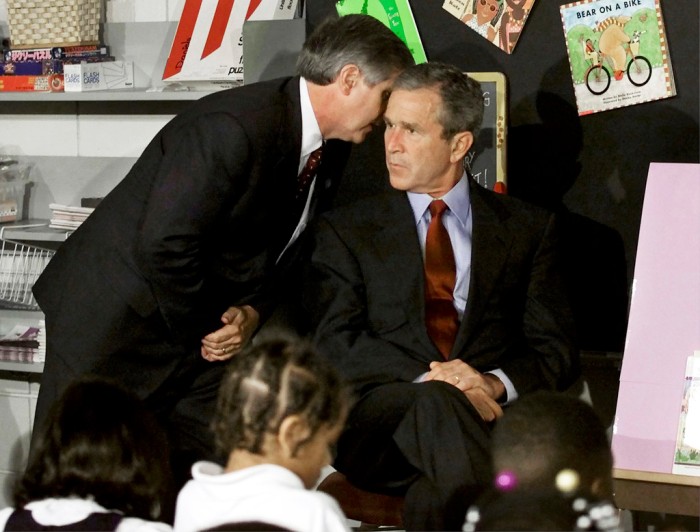
9/11 >“Mr. President, a second aircraft has hit the World Trade Center. America’s under attack.”
With these portentous words, the White
House Chief of Staff Andrew Card informed President Bush of the attacks.
Bush was reading to a class of Florida schoolchildren, and his shock
was palpable. Seldom are such crucial moments of a presidency recorded
live, and for Bush it was an especially watershed moment. Previously, he
had repeated said he was more interested in nation building at home
than interventions abroad, but he would ironically find himself becoming
a close ally with a country whose leader’s name he famously forgot.
Not wishing to alarm the kids, Bush
remained in that classroom for few more minutes; while the president was
initially lauded for his grace, as criticism grew in the following
years, the “Pet Goat” moment was increasingly pointed out as symptomatic
of his dithering presidency.
Original photo altered by 9/11 Bill of Rights


